

The History of Clothing - a History of the Plissé
What exactly is pleating (plissé)? When was it invented, and how did it evolve? Why do people wear pleated skirts, and why are they called that? How long has the technique been around, and is it still relevant today?
Pleating and the technique used to create it fascinate people around the world. Who came up with the idea? How is it done? All this and more in the article below.

A woman wearing a dress made from fabric pleated using the plissé technique, Photographed by: Magapls
What is plissé?
The word plissé (Plissé) means “pleats” in French. Originally, the term referred to fabric that was woven or gathered into folds. Today, the fabric is lightweight, with a crinkled, ridged surface. The term plissé can also describe a chemical finishing technique (for example, plissé fabrics used for underwear).
The plissé technique is based on placing fabric between two folded cardboard molds and applying hot steam until the cardboard’s folded pattern is set into the fabric.
Watch here as two plissé fans are opened and the finished fabric is taken out, from the Gérard Lognon atelier (Atelier Gerard Lognon)
Before we delve into the technique itself and what really happens during the process, here are a few words about the processes fabrics undergo and finishing.
What is fabric finishing? Finishing (Finishing) is a process intended to alter the properties of fabric. The process is carried out on fabrics and/or yarns. Fabric finishing is necessarily affected by the fiber composition of each fabric, and is therefore tailored to each type of raw material.
To carry out a finishing process, it is first necessary to know what each textile product is made of, since finishing is a chemical process that the fabric undergoes; certain chemicals can damage different types of fabric (for example, cotton is a cellulosic raw material, and cellulose is damaged by sulfuric acid. Wool is a protein-based raw material, and protein is damaged by a salt solution, etc.). The chemical composition of the raw material must be taken into account in the various finishing processes so that the appropriate chemicals can be selected.
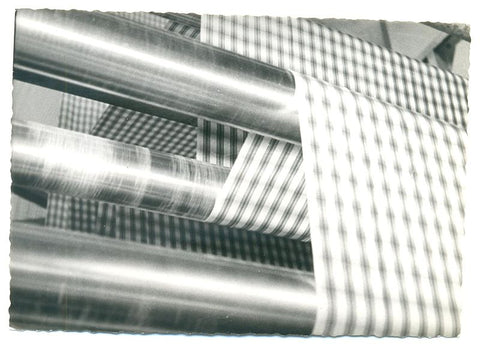
Fabric finishing process: part of a fabric-making machine, Photo: Fisher House – The Municipal Museum of Kiryat Ata History, from the Pikiwiki website,
The plissé technique is a type of finishing that aims to improve the properties and appearance of fabric. The process itself is called heat setting—thermal stabilization (Thermal Stabilization). It is intended only for synthetic fabrics (because they are thermoplastic fabrics whose properties change when heated). The process sets fabrics in a straightened state using hot air, allowing them to retain their shape over time. Fabrics treated this way do not shrink or become misshapen in the wash.
You can get a sense of the precise, hands-on process directly from the official Ateliers Lognon Instagram account
In the plissé process, the fabric is folded according to various origami patterns. Here is how it is done: fold a sheet of cardboard according to the desired pattern, then reproduce the fold on a second piece of cardboard, exactly the same size. Next, open out the pattern on the cardboard (so it is no longer folded), lay the fabric between the two layers of cardboard, press all the layers together, and begin folding all three (cardboard, fabric in the middle, and cardboard again). Once everything is ready, tie the mold together so it cannot open, then place it in an oven with steam for a length of time determined by the complexity of the pattern and the type of fabric.
The most basic and popular pattern throughout history is the accordion pleat (known colloquially as a “fan fold”). This pattern comes in simpler and more complex variations, such as sunray pleats and straight accordion pleats. There are also highly complex pleating patterns made by hand in a workshop (atelier). Examples can be found in France and England. These involve very complex patterns of folds, carefully made by hand.
You can also admire meticulous pleating work on the Maison du Pli Instagram profile
The history of the plissé technique
Throughout the history of fashion, clothing and textiles have served not only to keep the body warm but also as a means of visual communication, expressing the wearer’s status or position. To distinguish different fabrics and set them apart, a wide variety of techniques were invented to create different textures, volumes, and patterns. One of the earliest of these techniques is plissé.
See a unique pleated suit at London Fashion Week, by J.W. Anderson (J.W. Anderson), Spring 2014 (Look 19)
It may be hard to believe, but the plissé technique was already being used in ancient Egypt around 3000 BCE. The Egyptians used various molds to create folds in the fabric, then set the pattern with a heavy metal object.

Unlike other peoples, who used a large piece of fabric wrapped around the body (the basis of the draping tradition), Egyptian garments were made from several pieces of fabric sewn together into a single item of clothing (the basis of the tailoring tradition). Their garments were made partly or entirely using the plissé technique. Ancient Egyptian hieroglyphic paintings show kings and high-status men wearing short pleated linen skirts, sometimes paired with short linen shirts. Goddesses in Egyptian mythology were often depicted wearing pleated dresses, reflecting their high status.
About two thousand years later, during the European Iron Age (around 1000 BCE), pleats could be seen in the clothing of the wealthy and royalty. Pleats are also visible in paintings from ancient Greece (around 800 BCE), in the fabric of the Ionic chiton: two pieces of fabric fastened along the top with buttons at intervals. The Ionic chiton was also made from fine linen—the fabric was taken while wet, folded, and then fastened. The buttons that secured the fabric at the arms gathered it at clearly defined intervals, leaving holes around the buttons.

Illustration showing the structure of the Ionic chiton in ancient Greece: a broad linen panel fastened along the shoulders and arms with a series of small pins (fibulae), creating tiered sleeves and a richly pleated look. Illustration from Wikimedia Commons
Later, during the Middle Ages, two techniques for adding volume to fabric became very popular. The first involved setting the folds immediately after weaving linen or wool. The second involved changing the traditional weave pattern to create a stronger fabric that held its pleats better. The fabric was so strong that the pleats survived washing. During this period, people began pressing and smoking the fabric in an oven, or alternatively folding it by hand and setting it with an iron.
Clothing incorporating pleats was reserved for the upper classes. Throughout history, aristocrats, kings, and queens wore garments featuring the plissé technique, which symbolized volume, status, and wealth. Fabric folds also appeared later during the Renaissance, mainly in the upper part of garments: at the collar and sleeves. Rich fabric pleats were paired with luxurious jewelry made of gemstones and gold, making the neckline especially ornate and impressive.
Plissé as a fashion trend: a first in history
So far, we have seen examples of the plissé technique being used as a symbol of social status. However, during the 1920s and 1930s, plissé began to be used not only by the upper classes but also as a fashion trend: the technique was incorporated into dresses and skirts, everyday wear, and eveningwear. Later, plissé was also used in bags and hats. The Art Deco style, which gained momentum during those years, helped bring plissé into fashion. The style first appeared in France in the period before the outbreak of World War I, combining modern styles with fine craftsmanship and luxurious materials. It was characterized by meticulous attention to detail and represented luxury, glamour, abundance, and faith in social and technological progress.

And how can we talk about plissé without mentioning Marilyn Monroe’s iconic pleated dress? It was designed by American costume designer William Travilla. Monroe wore it in one of cinema’s most famous scenes, in the 1955 film "The Seven Year Itch".
Click here to view the iconic photograph of Marilyn Monroe in the white billowing pleated dress from the film "The Seven Year Itch" (1955), as originally published in the archive
Pleats Today
More than 5,000 years have passed since we first saw pleating in use, and we still enjoy wearing garments made from fabric folded using this technique today. Nowadays, the technique has been refined and industrialized through pleating machines that do not use heat. It can be applied to long lengths of fabric in a short time (although the quality of items made this way is lower than those produced using heat according to the traditional method).
There are also workshops with prestigious traditions in countries around the world, including France and England, that continue to produce high-quality pleats by hand. By heating the fabric in a high-pressure steam chamber, the folds are set into the fabric and made durable.
You can see Kate Middleton wearing her iconic red skirt
So, the pleating technique, once reserved exclusively for the upper classes, has now become accessible to everyone and is part of today's fashion culture. The volume and glamour that pleated fabric brings, along with the air of aristocracy and nobility associated with the technique, have endured to this day. So if you still don't have a pleated skirt, pleated dress, pleated collar, or pleated blouse, now is the time :)
*The post's featured image was photographed by Artem Podrez
Bibliography:
Houston, Mary G., Ancient Greek, Roman and Byzantine Costume and Decoration, London: A&C Black, 1977
Pleats, innovation and technology magazine, Holon Mediatheque
BOF website
Flickr account of Merja Attia


ממש מקצועי. מציג אותך כמקצוענית ומומחית בנושא. צריך מדי פעם להוציא עוד דברים כאלה לא בהכרח כאלה מפורטים וארוכים כדי לבסס מעמד של מובילה בתחום.
זו תשתית מצויינת לשיווק של המוצרים העתידיים שלך.
כל הכבוד
Leave a comment