

The History of Fashion – Tailored Buttoned Shirts, Detachable Collars, and Everything in Between
The classic tailored shirt as we know it today is an iconic garment with a fascinating history.

Nataliya Vaitkevich
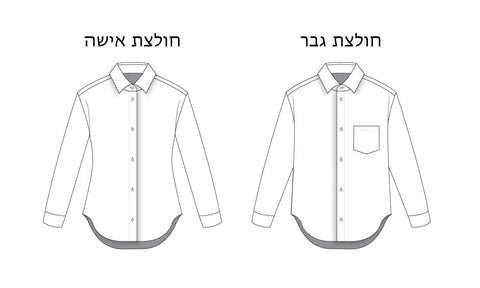
Throughout history, both women and men have worn button-up shirts, which use buttons to fasten the two sides of the shirt together and hold it against the wearer’s body. But there is a difference between women’s and men’s button-up shirts, and it stems from an interesting historical reason: the buttons on a woman’s shirt are on the left, while those on a man’s shirt are on the right. Why? Because buttons, a rare commodity in 13th-century Europe, were the preserve of wealthy women, who did not dress themselves but relied on servants to help them put on their clothes. Since most people were right-handed, it was easier for a servant standing in front of a lady to fasten her shirt. Men, on the other hand, usually dressed themselves, so their buttons were placed on the right, making it more convenient for the wearer to fasten his shirt himself.
And what about the color of the shirts? Men’s shirts came in a variety of patterns and colors, but the collars and cuffs remained white. The phrase “white collar” became a term referring not only to the physical color of the collar, but also a status symbol and social class. It is an informal term for people belonging to the middle class who worked in professional occupations that generally required a university education, including management, office and administrative work, marketing and sales, and, of course, the professions, such as law, architecture, and medicine. Throughout history, “white-collar” workers have been distinguished from “blue-collar” workers, who did dirtier jobs and manual labor. The “blue-collar” class is considered the working class, and the term itself became a name for workers’ work shirts.
The shirt itself was sewn with an attached collar. Some people did not wear collars at all (and some could not even afford to launder their collars...). As for the buttons, the shirt initially had a “half placket” (Half Placket), a shirt with a button opening that stopped halfway down. But it was difficult to get in and out of this shirt, leading to the development of the button-up shirt as we know it today. This shirt was worn like a coat, which is why it was called a “coat shirt” (Coat Shirt); it was easier to put on and take off. These shirts were longer than usual because they were also used as underwear, and men would tuck the shirt between their legs at the crotch, then wear trousers over it. Another advantage of the shirt’s length was that it did not come untucked. Even later, when men already had underwear, the shirt remained long and its length did not change.
The evolution of detachable collars and cuffs (Detachable Collars and Cuffs)
The detachable collar was invented by Hannah Montague (Hannah Montague) in the town of Troy, New York, in 1827. Hannah wanted to wash her husband’s shirt, and instead of washing the whole thing, she wanted to try washing just the collar (the part of the shirt that is most visible because it is always on the outside and can be seen even beneath an outer jacket). She cut the collar off her husband’s shirt to wash it, then sewed it back onto the shirt.
A local businessman, the Rev. Ebenezer Brown (הThe Rev. Ebenezer Brown), went on to commercialize her idea. From then on, the production of detachable collars, as well as the shirts associated with them, became an important industry in Troy.
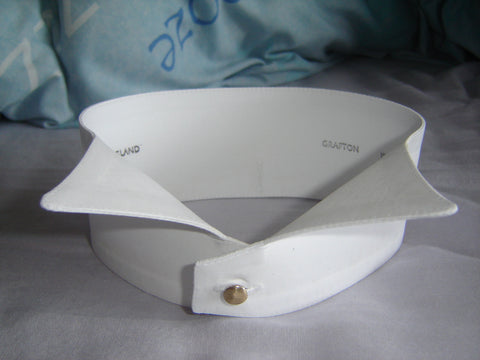
A detachable collar is a collar that is separate from the shirt and fastened to it with buttons. The collar is usually made from a different fabric than the shirt so it can be starched to a high stiffness (so that it feels and “stands” just like cardboard).
Later, for a short period, other parts of the shirt also became detachable, including the cuffs and the front of the shirt (parts that needed to be starched, so it was easier to starch them when they were detached from the shirt). The front piece was called a “detachable bib” (also Dickie Front, Detachable Bib, Shirt Front). The “detachable bib” was cheaper than buying shirts in different prints, and it was also easier to launder. It looked more polished because the starch kept it from wrinkling easily. Later, there was a greater emphasis on comfort, so these pieces were no longer starched, but the stiff collar was the last remnant of that heavily starched era to remain on the shirt.
The period between 1890 and 1920 was the heyday of detachable collars. During this period, a variety of shirts could be seen, but a pure white shirt was a sign of wealth and prosperity, while a striped shirt could conceal the fact that it was not washed regularly. This helps explain why a person wearing a crisp, ironed white shirt still symbolizes high status and social standing today.
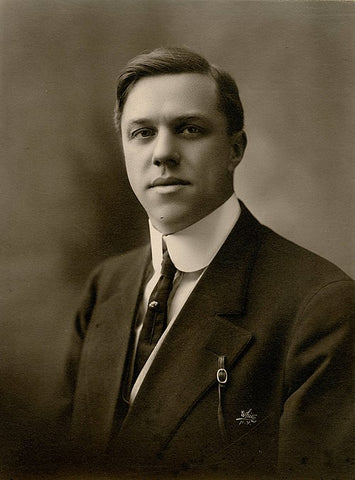
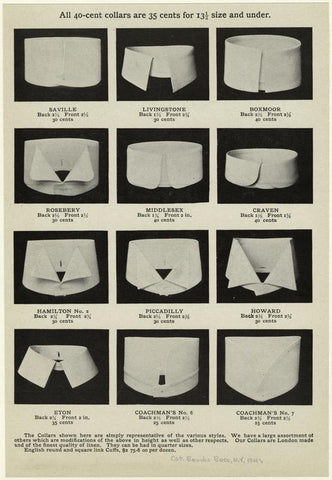
During this period, a variety of collar styles could also be seen, including stiff, starched collars, celluloid collars (celluloid Collar), which could be wiped with a rag instead of being washed each time, paper collars, and soft collars.
The collar was attached using 3 special fasteners called collar studs (collar stud): one shorter stud at the back, designed for just two layers of fabric, and two longer ones at the front, designed for four layers of fabric.
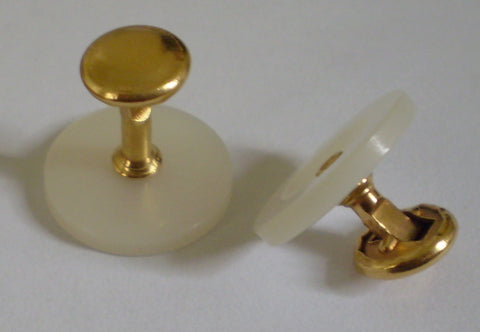
A pair of special fasteners for a detachable collar (Collar Studs): the long stud on the left is for the front (for four layers of fabric), and the short stud on the right is for the back of the shirt (for two layers of fabric). Image from Wikimedia Commons (Public Domain).
There was also an accessory called a “stud puller” (stud puller): a device that helped guide the stud through all the layers of fabric. The shirt was put on with the back button already fastened to the collar; then the tie could be put on, and only then were the front buttons fastened over the tie. Cufflinks made of two parts, called Bachelor Buttons, were used for the cuffs, and there was also another accessory called a “cuff holder” (Cuff Holder) that held the cuff and attached it to the sleeve.
You can explore the device’s construction and other historical clothing accessories in the catalog of the British brand Darcy Clothing.
Who else used detachable collars? Today, we know of one type of detachable collar that has survived through the years: the clerical collar (Clerical Collar or Roman Collar). Today, it is often made of flexible plastic so it can be cleaned easily. It is the only detachable collar that has survived to the present day, but detachable collars are still used today by lawyers in England, Ireland, and Canada. Many of them wear a wing collar in court and use bands to fasten it at the back of the neck (Collar Bands). These are two rectangular strips of fabric tied around the neck, forming formal attire associated with lawyers and academic dress.


The popularity of the detachable collar declined in the 1920s, with the rise of the men’s Oxford shirt.

Modern men’s Oxford shirt, photographed by Gallus Valdes
In conclusion, the button-down collared shirt as we know it today is a unique garment with a fascinating history. It is amazing to see how a piece of clothing that has become so basic and “classic” in our wardrobes is also a symbol of status and social standing that existed hundreds of years ago and has remained relevant to this day.
The next time you wear a crisp, ironed white button-up shirt, don’t forget the history behind this very special garment.


Leave a comment